Islamic Will Builder for Canadians: Estate Planning That Protects Your Family
Answer a few questions and get a complete Islamic will drafted for your family — free, no account needed, everything stays in your browser.
This builder is an educational drafting aid, not legal advice and not a fatwa. Have a lawyer review the final document before you sign it.
Before you start — is this builder right for you?
Two minutes here keeps you from entering details this tool can't handle. Your answers never leave your browser.
Children
Parents
The builder covers spouse, children, parents, grandparents, and siblings — the most common family structures. If your situation involves multiple marriages or other special configurations, the computed shares won't apply; consult a scholar and note it with your lawyer.
Siblings (full brothers and sisters, if no children and father is not living)
Grandparents (only if the corresponding parent is not living)
Assets & debts
List what you own and owe so your executor isn't guessing. Values are approximate and for identification only — exact figures come from your statements.
Real estate
Bank & investment accounts
Debts you owe
Money owed to you
Wasiyyah bequests (up to one-third of the estate)
Total bequests: 0.00% of the estate (max 33.33%)
Funeral wishes
Islamic funerals are simple and prompt: ghusl (ritual washing), kafan (plain shroud), salat al-janazah (funeral prayer), and burial facing the qibla as soon as possible — cremation is not permitted, and extravagant expenditure is discouraged. The default text below covers the essentials; adjust it to your wishes.
Beneficiary designations
Registered accounts (TFSA, RRSP, FHSA) and life insurance with a named beneficiary bypass the will — list them so nothing contradicts it.
Executor
Guardian for minor children
Witnesses (optional — pre-fills the signature block; they must still sign in person with you)
Email my will — we’ll send a 6-digit code to confirm the address, then email your draft there. No account needed.
Before you sign: have a lawyer review this document. To be valid in most provinces it must be signed by you with two witnesses present together — witnesses must be adults who are not beneficiaries under the will. Quebec residents: have a notary finalize it.
The 5-minute estate plan every Muslim investor needs
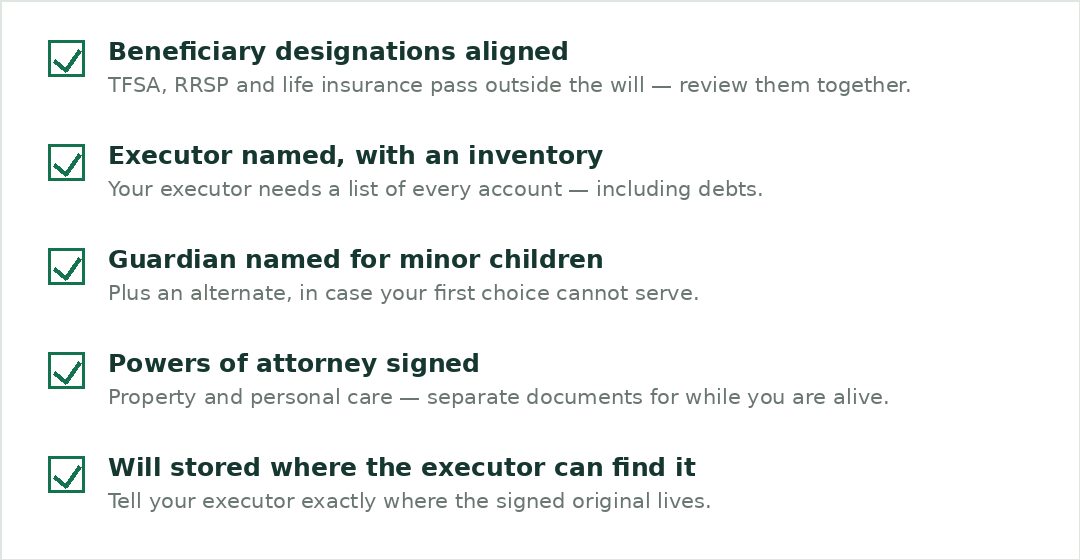
- Write the will. Debts first, then up to one-third as bequests (wasiyyah), then the Islamic fixed shares for the rest. The builder below drafts it.
- Align your beneficiaries. TFSA, RRSP, and life insurance with named beneficiaries bypass the will entirely — review them so they don't contradict it.
- Name an executor (and an alternate) and tell them where the will lives.
- Name a guardian for minor children.
- Sign powers of attorney for property and personal care — separate documents that matter while you're alive but incapacitated.
Why the province's default is not good enough
Die without a will in Ontario and the Succession Law Reform Act distributes your estate by a fixed provincial formula: a preferential share to the spouse, then splits with children, then parents, then siblings. Other provinces have their own versions. None of them replicate the Islamic inheritance shares — the fixed portions for spouse, parents, and children, with sons receiving twice the share of daughters. If you want Islamic distribution, you must write it down. The will is the instrument Canadian law gives you to do that.
The Islamic order of distribution
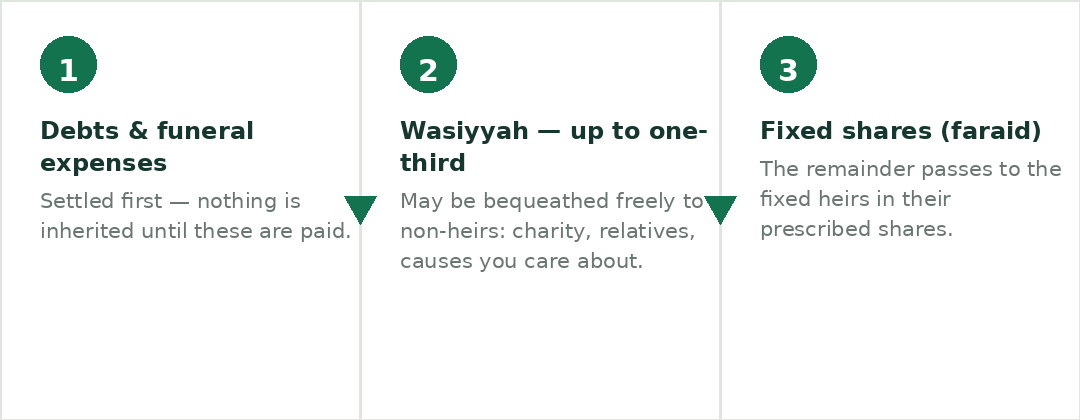
Islamic inheritance follows a strict sequence:
- Debts and expenses first. Funeral costs, outstanding debts, and taxes are settled before anyone inherits a dollar. As an investor, this means your executor needs a list of every account — including debts.
- The wasiyyah: up to one-third. You may bequeath up to one-third of the estate to anyone who is not already a fixed heir — typically charity, a relative who wouldn't otherwise inherit, or a cause you care about. It cannot be used to top up a fixed heir's share.
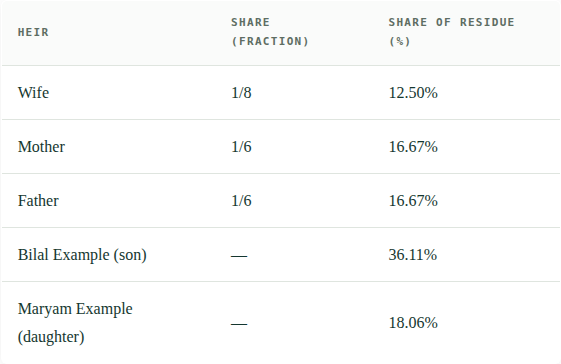
- The fixed shares. The remaining two-thirds (or more, if the wasiyyah is smaller) passes to the heirs in prescribed shares: a husband receives half if there are no children and a quarter if there are; a wife receives a quarter with no children and an eighth with children; each parent receives a sixth when there are children; children share the residue with sons receiving twice daughters' portions.
Scholars differ on edge cases — which is why the builder below covers the common family structures (spouse, children, parents, grandparents, and siblings) and flags anything complex for a scholar and a lawyer.
What the will can't do (the investor's blind spots)
- Beneficiary designations override the will. Your TFSA, RRSP, and life insurance go directly to whoever you named — the will doesn't touch them. Review these designations every time your will changes.
- Joint accounts pass by survivorship. A joint account with right of survivorship goes to the surviving holder outside the will.
- Dependants can still claim. In most provinces, a spouse or dependent child can ask a court for support from the estate regardless of what the will says. A will following Islamic shares should still provide adequately — discuss this with your lawyer.
- Quebec is different. Quebec's civil-law system has its own will formalities (including the notarial will). The template below follows common-law province requirements; Quebec residents should have a notary finalize it.
Frequently asked questions
Do Muslims in Canada need a will if Islamic law already sets inheritance shares?
Yes. Without a will, the province's intestacy law decides who gets what — and provincial formulas do not match Islamic inheritance shares. A will is the instrument that lets a Muslim Canadian direct distribution according to Islamic principles within Canadian law.
Can an Islamic will give everything to one person?
No. In Islamic inheritance law, only up to one-third of the estate (the wasiyyah) can be bequeathed freely to non-heirs or charity. The remaining two-thirds passes to the fixed heirs in their prescribed shares. Scholars differ on details, so personal questions belong to a qualified scholar.
What happens to my TFSA and RRSP when I die?
Registered accounts with a named beneficiary bypass the will entirely — the money goes directly to the beneficiary. That makes beneficiary designations part of your estate plan: review them whenever your will changes so the two don't contradict each other.
Is an online will template legally valid in Canada?
A will that meets your province's formalities can be valid: in most provinces that means written, signed by you, and signed by two witnesses present together (who are not beneficiaries). Quebec's civil-law system has different requirements, including the notarial will. A template is not legal advice — have a lawyer review the final document.
Who should be the executor of my will?
Someone you trust to be organized and fair under stress — often a spouse, sibling, or close friend. Name an alternate in case your first choice can't serve. Tell them where the will is kept and give them a list of your accounts.
Does Canadian Halal Investor store my will?
No. Everything you enter in the will builder stays in your browser — it is never stored on our servers. The one exception: if you tap “Email my will,” you’ll enter your email address and a 6-digit verification code, and the document is sent once to that address through our email provider, then deleted — it is never kept. Print or save the document yourself and store it somewhere your executor can find.
Keep reading
- Halal Investing in Canada: The 2026 Guide — the full playbook.
- Best brokerages for halal investing — where the accounts live.
- Zakat calculator — TFSA/RRSP/FHSA-aware.
- Ask a scholar — for personal rulings.